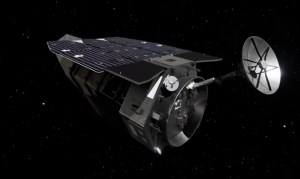
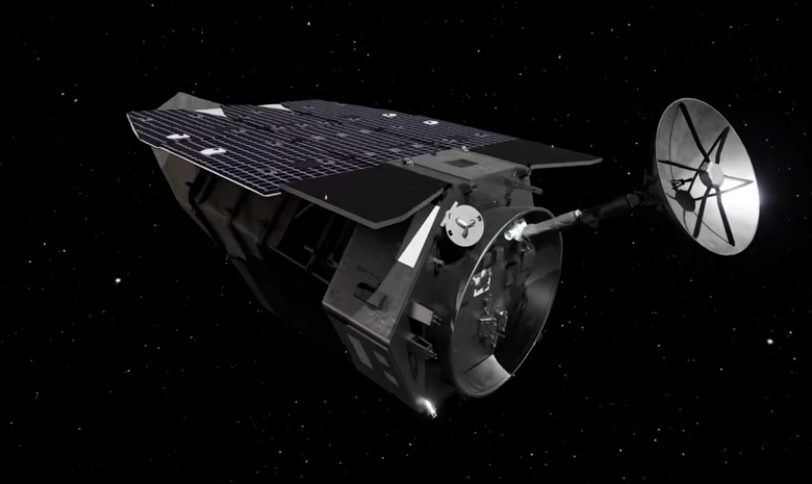
A powerful new space telescope is about to blast off on a mission to explore some of the universe’s biggest mysteries.
Nasa’s Nancy Grace Roman Space Telescope is due to launch from Kennedy Space Center in Florida, USA, on Sunday 30 August 2026, aboard a SpaceX Falcon Heavy rocket.
Its main mission will last five years and cost about US$4.3 billion, around £3.2 billion, though it could keep working for even longer after that.
Roman’s main mirror is 2.4 metres wide, the same size as the famous Hubble Space Telescope’s mirror. But Roman can capture an area of sky more than 200 times bigger in a single picture, so it should scan huge parts of space much faster than Hubble.
The telescope will also study infrared light, a kind of light human eyes can’t see, which can reveal objects hidden behind clouds of space dust.
Searching for new worlds
Scientists hope Roman will discover more than 100,000 exoplanets, the name given to planets that orbit stars outside our solar system.
It will search in two ways. One method looks for a tiny dip in a star’s brightness when a planet passes in front of it.
The other, called gravitational microlensing, looks at what happens when one star passes in front of another star further away. The nearer star’s gravity bends the distant star’s light and makes it look brighter for a short time. If a planet is also travelling around the nearer star, its gravity causes an extra change in that brightness, which helps scientists work out that a planet is there.
Dr Eamonn Kerins, from the Jodrell Bank Centre for Astrophysics at the University of Manchester, is helping to lead this search.
“The science we expect Roman to deliver will be simply incredible, transforming our understanding of planets around other stars,” he said.
Solving mysteries of dark matter and dark energy
Roman will also study two of the universe’s biggest mysteries: dark matter and dark energy.
Scientists can’t see dark matter directly, because it doesn’t give off or reflect light. But they know it’s there because its gravity affects how stars and galaxies move. Roman will study millions of galaxies to help map where this hidden matter might be.
Scientists have also found that the universe is expanding, meaning the space between faraway galaxies is growing, and that this seems to be speeding up. Dark energy is the name given to whatever might be causing that. Roman will measure the positions and distances of galaxies to help work out how the universe’s expansion has changed over billions of years.
Scientists think about a quarter of the universe is made up of dark matter, and around seven-tenths is dark energy, but they still don’t know exactly what either one is.
It could take years for scientists to fully understand what Roman finds, but its journey to help answer some of space’s biggest questions begins this weekend.


 SMART Prep | Quick Question