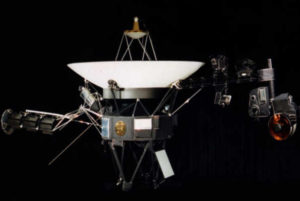


NASA’s Voyager 1 spacecraft has become the first human-made object to reach one light-day from Earth. It passed the milestone on 18 November 2026.
A light-day is how far light travels in a whole day. Voyager 1 is now about 26 billion kilometres away, more than four times as far as Pluto is from the Sun. That means a signal sent from Earth takes 24 hours to reach the spacecraft.
Voyager 1 is about the size of a small car and launched from Florida, in the United States, on 5 September 1977. Along the way, it photographed Jupiter, Saturn and Titan, which is Saturn’s largest moon.
In 1990, it took 64 pictures that together made the first “family portrait” of the solar system. In 2012, it moved beyond the reach of the Sun’s magnetic field and into interstellar space, which is the space between stars.
The spacecraft has lasted far longer than anyone expected, but eight of its 10 science instruments no longer work. Within the next ten years, scientists may receive its very last signal.
For now, Voyager 1 is still sending back information about space beyond our solar system. Next year, it and its twin, Voyager 2, will both have been in space for 50 years.
Te Reo Māori
Pānui: Kua tae a Voyager 1 ki te tawhiti o te light-day kotahi i Papatūānuku
Ko te waka ātea a NASA, a Voyager 1, te mea tuatahi i hangaia e te tangata kua tae ki te tawhiti o te light-day kotahi i Papatūānuku. I tae atu ia ki taua tohu i te 18 o Noema 2026.
Ko te light-day te tawhiti e haere ai te marama i te roanga o te rā katoa. Kei te tata ki te 26 piriona kiromita te tawhiti o Voyager 1 i tēnei wā, neke atu i te whā whakareatanga o te tawhiti o Pluto i te Rā. Nō reira, e 24 hāora te roa kia tae atu tētahi tohu i tukuna mai i Papatūānuku ki te waka ātea.
He rite te rahi o Voyager 1 ki tētahi motukā iti, ā, i whakarewaina mai i Florida, i Amerika, i te 5 o Hepetema 1977. I tōna haerenga, i tango whakaahua ia o Hupita, o Hatana, me Titan, te marama nui rawa o Hatana.
I te tau 1990, i tango ia i ngā whakaahua e 64, ā, i hanga ngātahi ai te “whakaahua whānau” tuatahi o te pūnaha o te Rā. I te tau 2012, i haere ia ki tua atu o te papa autō o te Rā, ki te ātea i waenganui i ngā whetū.
Kua roa ake te ora o te waka ātea i tā te katoa i whakaaro ai, engari kua kore e mahi ngā taputapu pūtaiao e waru o ōna taputapu e 10. I roto i ngā tau tekau e heke mai nei, tērā pea ka whiwhi ngā kaipūtaiao i tōna tohu whakamutunga rawa.
I tēnei wā, kei te tuku mai tonu a Voyager 1 i ngā mōhiohio mō te ātea i tua atu o tō tātou pūnaha o te Rā. Ā tērā tau, ka 50 tau a ia me tōna māhanga, a Voyager 2, e noho ana i te ātea.

 SMART Prep | Quick Question