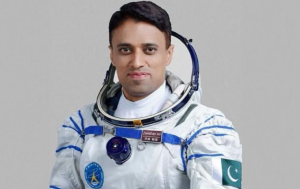
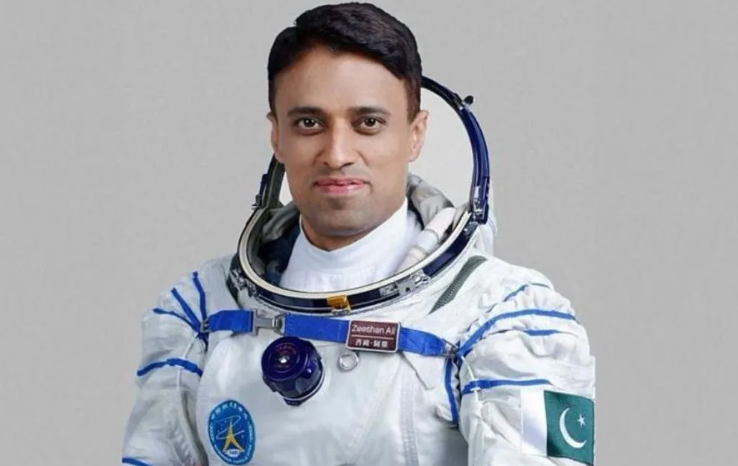

Muhammad Zeeshan Ali has become the first person from Pakistan to travel into orbit, and the first astronaut from outside China to visit its Tiangong space station.
The 40-year-old blasted off on a Chinese-made rocket from the Jiuquan Satellite Launch Centre in northwest China, and docked at the space station early on Wednesday.
A space station is like a giant science lab that circles high above Earth, where astronauts live and do experiments.
Ali will stay for five to 10 days, which is much shorter than the six months Chinese astronauts usually spend there. He trained in China for months to get ready, and even learned to speak Chinese.
“I’m not flying for myself. I carry the name of Pakistan on my shoulder,” Ali told reporters on Tuesday.
Pakistani Prime Minister Shehbaz Sharif said the trip was “the journey of 240 million Pakistanis”. That’s about how many people live in Pakistan.
The mission also matters to China, which wants to show the world that other countries can use Tiangong for research too.
China hopes to land an astronaut on the Moon by 2030. The United States aims to send people back there in 2028, for the first time since 1972. China also plans to build a research base on the Moon with Russia by 2035.
Both China and the United States say they only want to use space peacefully.
Te Reo Māori
Upoko: Kua eke te kaiarorangi tuatahi o Pakistan ki te teihana ātea o Haina
Ko Muhammad Zeeshan Ali te tangata tuatahi nō Pakistan kua haere ki te ātea huri ai i te ao. Ko ia hoki te kaiarorangi tuatahi nō waho o Haina kua toro ki tana teihana ātea, ki Tiangong.
I rere atu te tāne 40 tau te pakeke i runga i tētahi tākirirangi i hangaia e Haina, mai i te Jiuquan Satellite Launch Centre i te raki-mā-uru o Haina. I hono atu ia ki te teihana ātea i te atatū o te Wenerei.
He rite te teihana ātea ki tētahi taiwhanga pūtaiao nui e huri haere ana i runga noa atu i te ao. Ka noho ngā kaiarorangi ki reira, ā, ka mahi whakamātau rātou.
Ka noho a Ali ki reira mō te rima ki te 10 rā. He wā poto ake tēnā i ngā marama e ono e noho ai ngā kaiarorangi o Haina i te nuinga o te wā. He maha ngā marama i whakangungu ai ia i Haina kia rite ai ia, ā, i ako hoki ia ki te kōrero i te reo Haina.
“Ehara i te mea mōku anō tēnei rerenga. Kei runga i tōku pokohiwi te ingoa o Pakistan,” te kī a Ali ki ngā kairīpoata i te Tūrei.
I kī te Pirimia o Pakistan, a Shehbaz Sharif, ko tēnei “te haerenga o ngā tāngata 240 miriona o Pakistan”. Koinā tata te maha o ngā tāngata e noho ana ki Pakistan.
He mea nui hoki tēnei mō Haina. E hiahia ana a Haina ki te whakaatu ki te ao ka taea hoki e ētahi atu whenua te whakamahi i Tiangong mō te rangahau.
E hiahia ana a Haina kia tau tētahi o ōna kaiarorangi ki te Marama hei te tau 2030. E whai ana a Amerika kia hoki anō he tāngata ki reira hei te tau 2028, te wā tuatahi mai i te tau 1972. Kei te whakamahere hoki a Haina rāua ko Rūhia ki te hanga i tētahi pokapū rangahau ki te Marama hei te tau 2035.
E kī ana a Haina me Amerika, ko te rangimārie anake te take o ā rāua mahi ki te ātea.

 SMART Prep | Quick Question