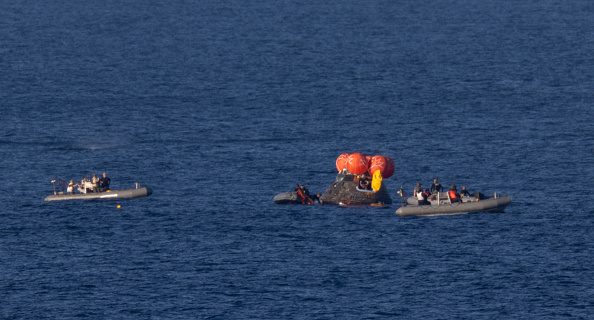

NASA’s Artemis II spacecraft splashed down in the Pacific Ocean on 10 April 2026, bringing four astronauts safely back to Earth after a mission of nearly 10 days. The Orion capsule landed off the coast of San Diego at 8:07 p.m. Eastern Time, ending a journey of 694,481 miles around the Moon and back.
Coming home from space is one of the hardest parts of any mission. Orion had to race through Earth’s atmosphere at very high speed, then slow down in careful stages. NASA said two drogue parachutes opened first at about 22,000 feet to steady the capsule, and then three main parachutes opened at about 6,000 feet to slow it for landing in the sea.
After splashdown, recovery teams quickly moved in. NASA engineers carried out checks while Orion floated in the water, and then a joint NASA and U.S. military team helped the astronauts out of the capsule. The crew were taken by helicopter to the USS John P. Murtha, where they had their first medical check-ups after the mission.
The return was carefully planned because astronauts can feel weak or dizzy after days in space. Recovery teams train for years so they know exactly what to do, from reaching the capsule to lifting the crew to safety. NASA also practises this work to make future Moon missions even safer.
For the Artemis astronauts, the splashdown was the final dramatic moment of a historic trip. It showed that Orion can carry people far from Earth and bring them safely home again. That is a big step for NASA as it prepares for even more ambitious journeys to the Moon in the years ahead.

 SMART Prep | Quick Question